
‘Choosing your Bible lens’ by Stephen Welbourne - 5 July 2026
How does the way we look at the Bible change what we think it means, and how we live as a result? Stephen Welbourne takes inspiration from Zach Lambert’s “Better Ways to Read the Bible” and Danielle Strickland’s “Right Side Up” podcast (from April 27th 2026), and looks at what happened when Jesus met a woman accused of adultery. This story has been seen in lots of ways. If it can help us to see Jesus’ approach, it can also help us to treat people and brokenness effectively and avoid weaponising religion. What stands out to you from this story?
Notes
What is a Bible Lens?
A set of assumptions all of us bring to reading the Bible
Can be unconscious but can also be intentional
We can’t avoid reading the Bible through a Lens but we can choose which lens we want to use.
Harmful lenses include Literalism, Apocalypse, Moralism and Hierachy.
Healing lenses include Jesus, Context, Flourishing and Fruitfulness.
The story
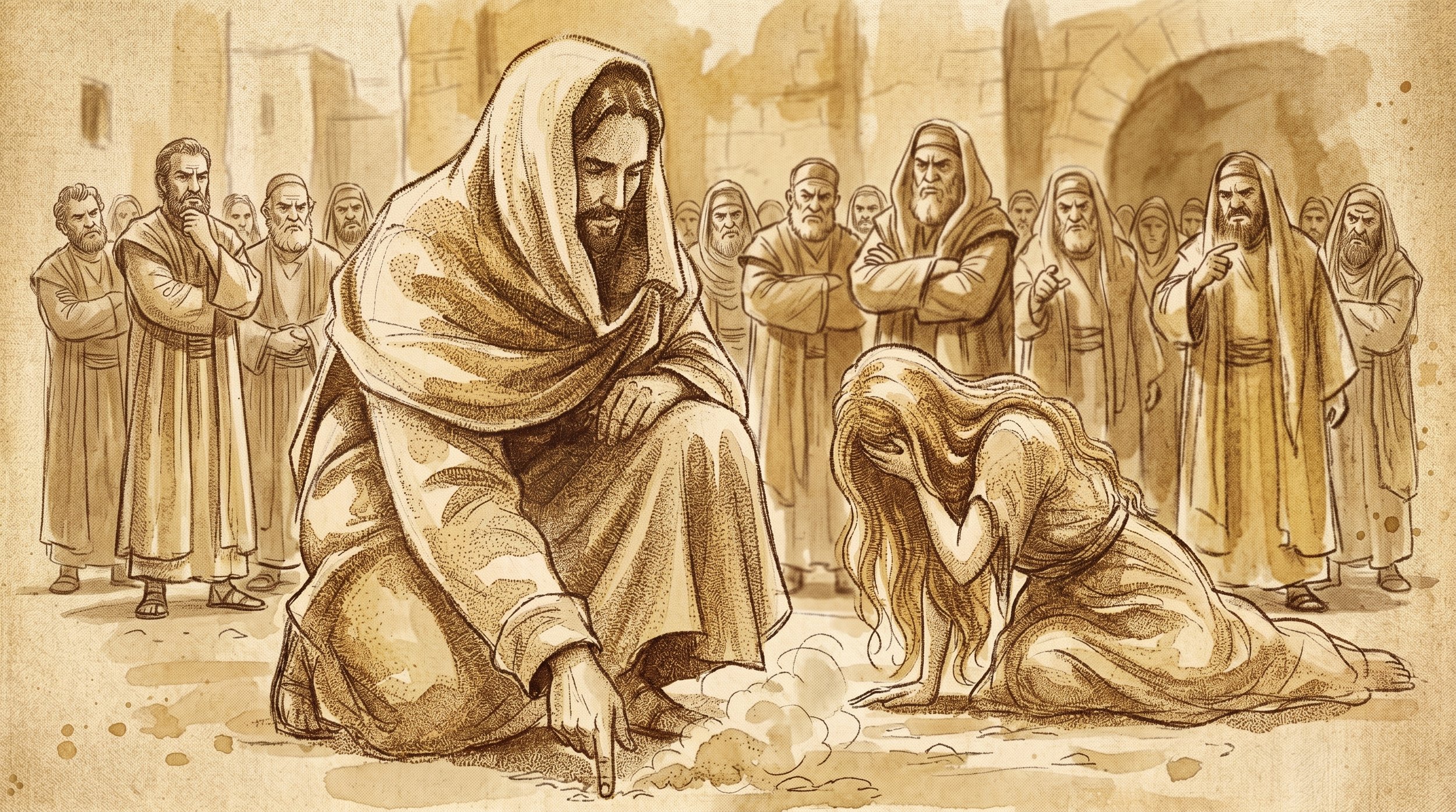
At dawn he appeared again in the temple courts, where all the people gathered around him, and he sat down to teach them. The teachers of the law and the Pharisees brought in a woman caught in adultery. They made her stand before the group and said to Jesus, “Teacher, this woman was caught in the act of adultery. In the Law Moses commanded us to stone such women. Now what do you say?” They were using this question as a trap, in order to have a basis for accusing him.
But Jesus bent down and started to write on the ground with his finger.7 When they kept on questioning him, he straightened up and said to them, “Let any one of you who is without sin be the first to throw a stone at her.” Again he stooped down and wrote on the ground.
At this, those who heard began to go away one at a time, the older ones first, until only Jesus was left, with the woman still standing there. Jesus straightened up and asked her, “Woman, where are they? Has no one condemned you?”
“No one, sir,” she said.
“Then neither do I condemn you,” Jesus declared. “Go now and leave your life of sin.”
(John 8:2-11)
How is this story relevant today?
Women (and occasionally men) are still being stoned for adultery in several countries including Iran, Afghanistan, Sudan and Somalia.
Weaponization of Religion is all around us - particularly on social media. We can learn from this passage how to combat it.
Jesus’s refusal to condemn the women is also echoed in his refusal to condemn us for our sins.
Romans 8 v1-2 ‘Therefore, there is now no condemnation for those who are in Christ Jesus, because through Christ Jesus the law of the Spirit who gives life has set you free from the law of sin and death.
Prayer points
Some of us may identify with the woman in the story in our current situations - please ask for prayer from anyone who you feel safe with.
We may know of people in vulnerable situations like this. Let’s pray for Jesus to be present in those situations.
Weaponization of Christianity against vulnerable individuals and communities has become widespread, particularly in America and Russia. Let’s pray that in the same way that the Pharisees were exposed as hypocrites that God would expose the underlying motivations of those seeking to weaponize Christianity.
Danielle Strickland’s revelation on preparing a sermon on this passage was that she identified most closely with the Pharisees. It prompted her to set up a group called Pharisees anonymous. If you are brave enough, why not ask the Holy Spirit to show you where you need to surrender Pharisaical views?
Pray for organizations like Amnesty International that are working to abolish stoning as a legally approved punishment.
Links
“Better Ways to Read the Bible” by Zach Lambert - Amazon.co.uk link
Danielle Strickland’s podcast - link