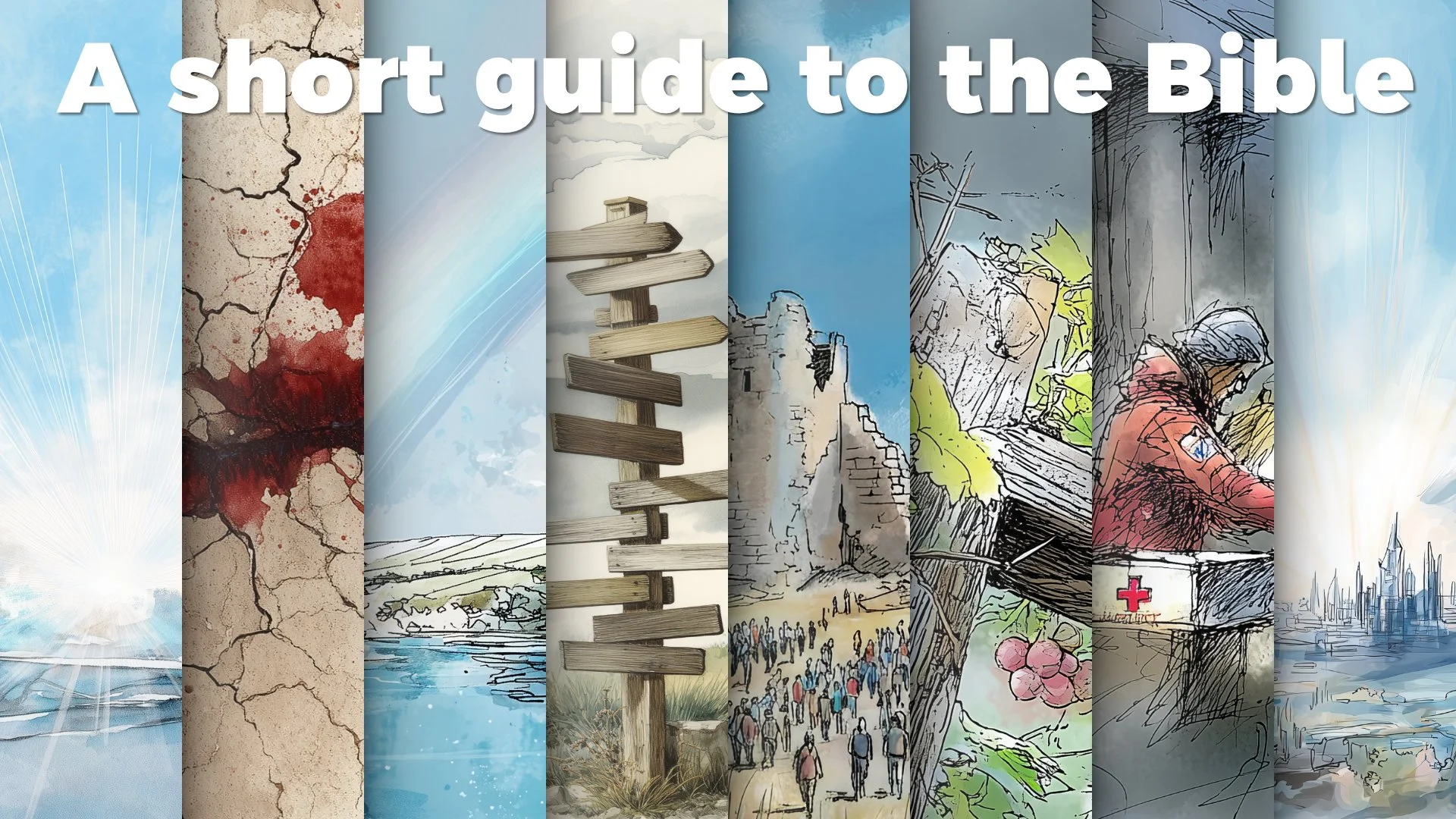
‘A short guide to the Bible (part 1)’ by Claire Lynch - 25 January 2026
How can we get to grips with the Bible and what it means? Claire Lynch looks at how it fits together lots of stories as part of one big story of life, purpose, relationships, struggles, suffering, hope and fulfilment. Can looking at the Bible as a box set with recognisable episodes help us to explore it and connect it with our lives today?
Links to books mentioned
How to Read the Bible Well by Stephen Burnhope
Reading the Bible with Its Writers by Stephen Burnhope
Transcript
I’d like to ask you a question, to ponder for a moment..
How do you feel about the Bible?
Your first thought might be, “well of course, I love the Bible, it’s the lamp to my feet and the light unto my path!!” And that might well be the case!
but
….take a moment, are there any other feelings you might associate with the Bible?
How about confusion? Have you ever been confused by some of the language, or some of the stories, some of the ways people or God are portrayed? Some of the seemingly contradictions? Or does it all always make total sense??
How about scared?? Have you ever been afraid by something you’ve read, maybe something you haven’t wanted to hear, something that challenges you, makes you feel uneasy??
How about overwhelmed? Maybe you’ve been asking questions about the Bible, which have led to other questions and more questions and you’re now thinking that you probably need a Theology degree to really understand it and what’s the point in trying.
Maybe, you haven’t yet read any of the Bible and quite frankly it’s a mystery to you why anyone would place such high value on it.
It’s likely we have mixed emotions towards the Bible - on the one hand we may have got a lot of comfort and inspiration from the Bible and yet at other times it may have caused us a lot of angst as we’re heard conflicting opinions on what certain things mean and how they apply our lives.
Owen and I have a good friend Steve Burnhope, who is a speaker, writer and theologian - reading the Bible well and helping others do so, is a great passion of his, something he has dedicated many years to. For no other reason, that reading the Bible well connects us to God, but NOT reading it well can lead to all sorts of problems! -in our relationship with God, each other and our world.
If you are interested, a couple of books that Steve has written are: “How to Read the Bible Well” and “Reading the Bible with Its Writers” - both aimed at everyday people who don’t necessarily have a theology degree, but who want to feel comfortable with reading the Bible, and to be able think critically and ask questions (which is actually to think theologically) and would like to have clarity on some of the misunderstandings.
I’d really recommend those books, but Steve is very generous with his material, and so I’ve used some of his work as the basis for this 2 part mini series, that I’m starting today. I have adapted some bits for this context.
If you prefer to listen to things, then I can also highly recommend a great podcast series called ‘The Bible for normal people.’ Which in a light hearted way addresses many of the common questions people have about The Bible.
So today is Part One of A short guide to the Bible, with the second part coming in a few weeks time.
Next time, I’m going to be exploring questions like ‘What actually is the Bible? How did we get it and what is is for?
The reason these questions are important is that if we don’t understand what the Bible is and what it isn’t, if we don’t understand what it’s for and what it’s not for, then we may be expecting and getting the wrong things from it, without realising.
If we want and expect to hear God through reading the Bible, then we need to be understanding the Bible well, if we want to be confident that we are hearing God right.
So next time, we will look at a few of those questions but today, I just want to begin by looking at nature of the Bible.
The nature of the Bible
What kind of book is the Bible? You may have heard people describe the Bible as God’s instruction manual, a guidebook on how to live. Which is fine until you look for the section with the instructions in, or you look to some guidance from the chapters at the beginning, and realise most of the books are written after peoples names or have words that don’t quite make sense like Leviticus or Numbers.
According to Google, an instruction manual is:
…a document that provides clear, step-by-step directions on how to install, operate, maintain, or troubleshoot a product, service, or application to ensure users can use it safely and effectively. They use simple language, action verbs, and often include diagrams, photos, or videos to guide users through tasks, breaking complex processes into manageable chunks for successful completion.
If you are expecting The Bible to be like an instruction manual you’ve previously used, you’ll be sorely disappointed!
Yes the Bible does include instruction, absolutely, but you may be surprised to know that the vast majority of the Bible - about 75% of it, is actually ‘story’, or ‘narrative’.
And when I say story, it’s actually stories, within stories, within a BIG story. Like a set of Russian dolls, stories within stories, within God’s BIG story.
In the Bible, the story of God is told though the stories of people
Even the story of Jesus comes to us through the stories of the people who knew Jesus, and met Jesus, and experienced Jesus.
Have you ever wondered why JESUS didn’t write any of the New Testament?
For some reason, God decided that everything in the Bible should come to us through the eyes of people. The memories of people, the perspectives and the experiences of people.
So what IS the “Big Story” of the Bible all about?
Some people choose to skip the Old Testament completely, and start the story with Jesus at the beginning of the New Testament. Which is OK to a point, but the problem is that the first 3/4 of the Bible is what happened before Jesus. Jesus came into a story that God had already been involved in for thousands of years.
So how can we explain the Big story of the Bible, cover to cover, in a way that’s both easy to remember and makes sense?
There are many ways that we can explain this but today, I want to suggest that we think of the Bible a bit like a Box set, that we might watch on TV, a Box set made up of three seasons.
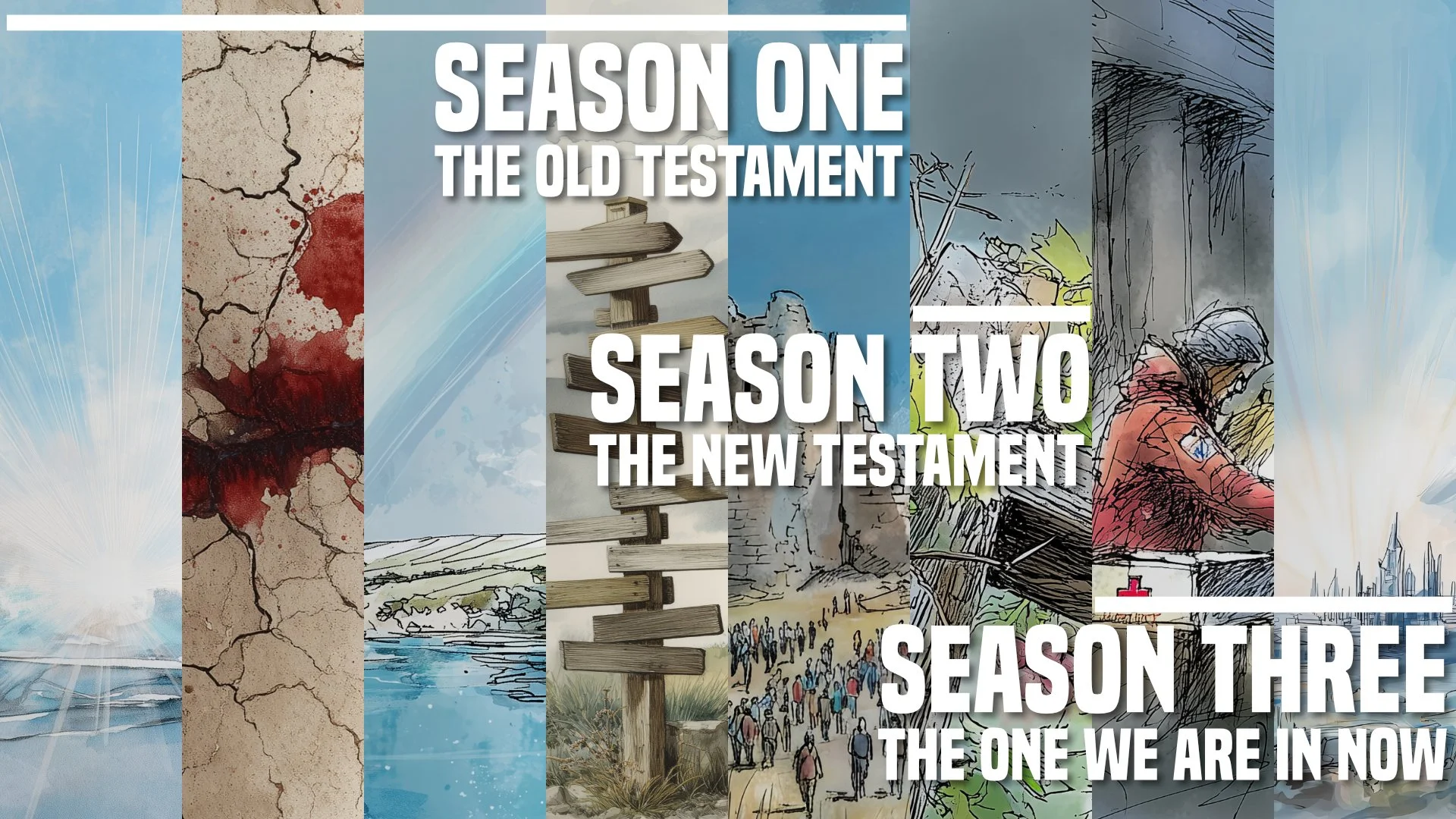
Season One — the Old Testament.
Season Two — the New Testament.
And Season Three — the one that we’re in now - where we are part of the story.
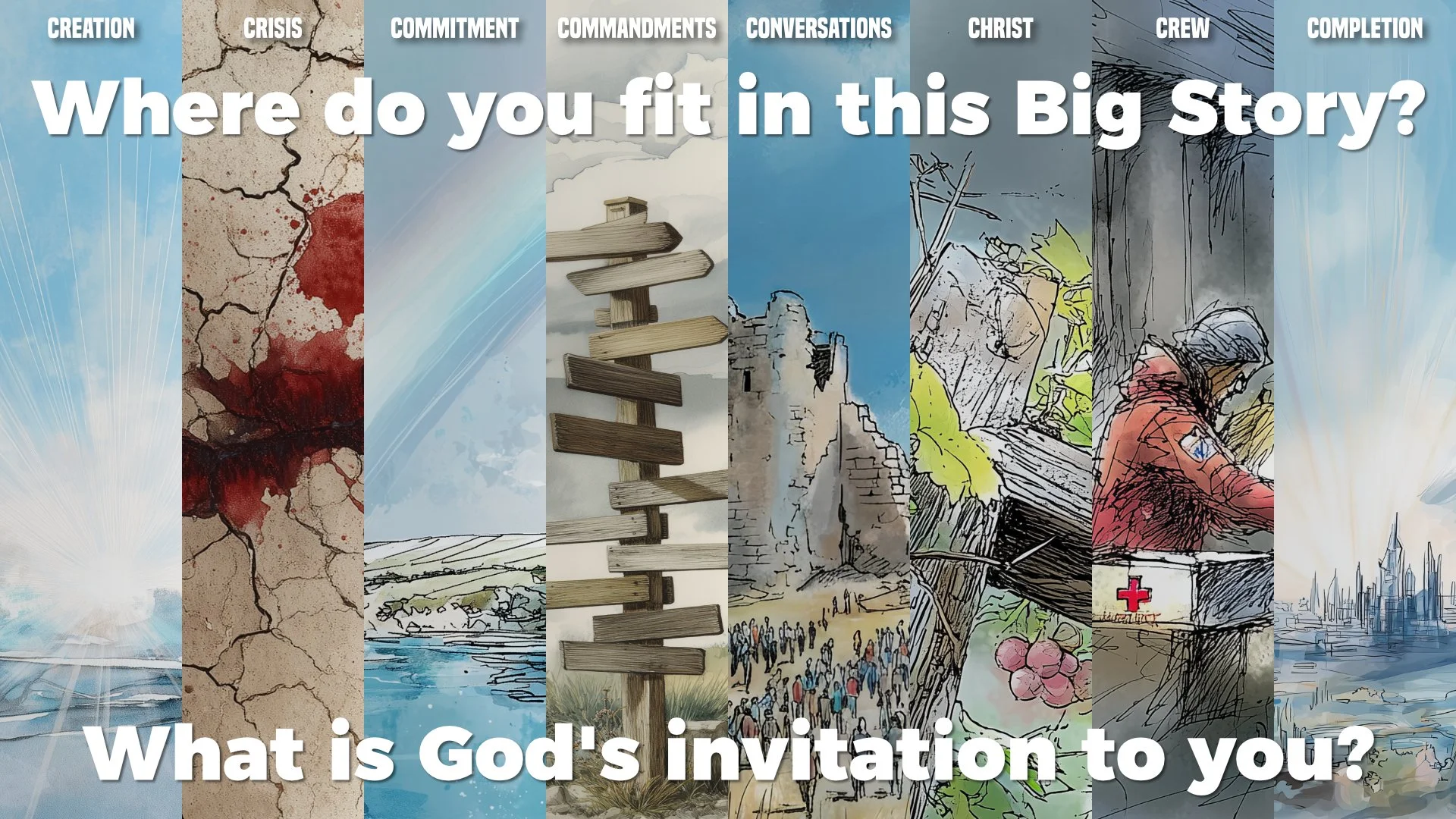
As we do that — I’d like us to imagine 8 key episodes. They all begin with the letter C, so it’s easy to remember.
But the idea is that, once we have this big picture in mind, it will give us the hooks to hang whatever we are reading on, from anywhere in the Bible and understand where it fits in the overall story.
Season One, Episode - 1: Creation
So we are going to start with Season One, episode one, which is our first C. C for Creation which we see described in Genesis, the first book in the Bible.
The book of Genesis is allegorical, meaning that this is not meant to be a literal, scientific, step by step, record of HOW the world was made but instead it uses imagery to communicate a deeper meaning. The question it was trying to answer was not How the world was made, but Who made the world and Why the world was made and What is God like. These are the questions the people of that time were asking.
We see in the story in Genesis, God, “speaking into being” an incredible world, full of beauty, and majesty, and mystery.
Each time God created something — he said it was “good.”
And when he’d finished, he looked at the whole package together — and said it was “very good.”
And despite everything bad that’s happened to his Creation since then, God has never stopped seeing it that way.
Which is why, even in its damaged state and our damaged state , God believes it’s worth rescuing and restoring. And that we are worth rescuing and restoring.
Now we see from the story that the high point of God’s Creation is people, because unlike everything else humans were “made in God’s image.”
Which is a wonderful phrase, but it’s also mysterious, because Genesis doesn’t tell us what it means by that. But we can see from Jesus that it probably means these 3 things:
Firstly, that as human beings we have the potential to know God personally - He designed us for relationship with him. And Genesis pictures the intimacy of that relationship in Adam and Eve walking with God in the Garden of Eden. God being personally present.
Secondly, that we were made with the potential “to be like him” by sharing in his eternal life.
And thirdly, there is the potential for our lives to be defined by the very thing that, more than anything else, defines God.
And that is love. Which is why Jesus said that the two greatest commandments are to love God and to love each other.
But when God created human beings, for our love for God to be real, God had to take a risk when he created us. If God forced us to love him or forced us to love each other, we would just be like robots — doing what we’re told.
The risk God took was giving us a choice, in what we call “free will.” Free will which includes choosing to love God back, or to not. That’s the only way our love could be real.
So in the story in Genesis, when Adam and Eve decided to do the ONE thing that God had asked them NOT to —eating the fruit from the tree of knowledge of good and evil — they were exercising that free-will.
Their choice to do something God had asked them not to do was Adam and Eve saying..
“We’ll decide for ourselves what’s right and wrong — thanks very much.” “We’ll choose how we’re going to live, what’s right for US.”
That’s freewill.
Now when we read about “Adam and Eve”, it’s important to recognise there’s some “wordplay” going on that would have been obvious to the original audience of the story.
The Hebrew word ‘adam ‘ (which we take the name Adam from) is actually the word for “mankind” — or “humanity”.
So the story’s NOT just talking about one original man and woman — the story is talking about all of us, it’s painting a picture of what we are ALL like - all made in the image of God, all with free will.
Season One - Episode 2: Crisis
So as we move onto Episode 2— this “very good” Creation soon ends up in “Crisis.” Our second C.
Through freewill, we see selfishness and independence and a desire to be in control increasingly dominating human life.
Not just Adam and Eve, but Cain and Abel, Lamech, the Tower of Babel. All these stories together are painting a picture.
Not just of one Crisis, caused by one couple eating a piece of fruit that they shouldn’t have, but a whole series of crises. Of broken relationships, with God and with each other.
We see selfishness taking control and when selfishness takes control, it soon leads to violence, personal violence, military violence, slavery and oppression.
Somehow, even the natural world is knocked off kilter, with earthquakes and hurricanes and floods — Natural disasters mirroring the spiritual and relational disasters.
And because the wrong choices humanity makes have consequences, this selfishness, independence and desire to be in control causes humanity to lose that intimate, personal relationship with God that we were designed for.
So how could God restore this wonderful Creation, without scrapping the lot and starting again.
Something fundamental about who humanity had become, needed to be transformed.
And it would need God himself to DO something to make that possible.
Season One, Episode 3 - Commitment
So as Season One continues — we see this Crisis that humanity has made, giving way to a commitment or a covenant, our third C — that GOD makes.
A solemn promise that he repeats, again and again, to different people in different stories, throughout Season One.
This Covenant is God committing to rescue his creation.
And this rescue mission starts with a commitment to a family - the most unlikely people as heroes, an elderly couple, Abraham and Sarah far to old to have children. And God promises that he will give Abraham and Sarah children, and grow their family so big that it will be a great nation, that will be a blessing for the rest of the world.
In Genesis 12:2 God says to Abraham:
“I will make you a great nation — and I will bless you — so that you will be a blessing.”
And that’s still how God works.
He doesn’t just bless US so that we’re blessed, but so that we will BE a blessing.
So God chooses this family to become a nation, called the Israelites, that will start to “model” what life can look like when lived in relationship with God.
And it’s at THIS point that the Story separates into two different tracks
Like when the M6 Motorway — divides into two, the M6 toll and the regular M6 - and then rejoins again later
What has, until this point, been the Story of ALL people — for a while becomes the story of ONE people group, the Israelites, running in parallel with the story of all the other nations known as “the Gentiles.”
For the rest of Season One, the story mostly focuses on the Israelites.
Now this family that has grown to become the nation of Israel, unfortunately finds itself in slavery in Egypt.
But God miraculously, rescues them and leads them to a promised land where, they can now live in freedom as their own nation.
Now it’s important to recognise that the Israelites had been slaves in Egypt for multiple generations. And as slaves they would have been told what to do and how to live. They would have had other people’s laws imposed on them.
They wouldn’t have had freedom to organise and govern their own community and so now as a free nation, they needed God to help them and give them a comprehensive framework for how they should live as a nation and as a people of God.
Season One - Episode 4: commandments
Which brings us to our next “C” — for “Commandments.”
But this is not just the famous 10 Commandments given to Moses on the side of a mountain, there was actually 613 of them!
These commandments are referred to in our English translations of the Bible as ‘The Law” but it’s actually not a very helpful term for us today when we read that word in the Bible, because it gives us the wrong impression.
For some it’s led to the impression that God is obsessed with rules, that he demands his own way in all kinds of minutia and could smite you in his anger at any moment if you get something wrong.
But that would be a complete misreading of what was going on here.
The Hebrew word, badly translated as “Law” is Torah and it means “direction,” “guidance” or “instruction”, in the sense of teaching or schooling.
So God is teaching them how to live well as a community, as the people of God. He told them not to live how people in Egypt lived, the land they’d come from or in Canaan, the land they were going to.
All they had to do was follow Torah and this would enable them to be in right relationship with God and right relationship with each other. Loving God and loving people.
But over time, this became more tricky. You see, as time went on, Israel evolved from being a nomadic people to a settled people and as a result they needed more and more interpretations as to what those original commandments looked like, in these new situations.
And different rabbis had different ideas on that. Midrash was the common Jewish practice of debating how the Torah now applied to them in their new situations. (Which doesn’t sound that dissimilar to some of the conversations we might have about the Bible!). It’s why people were always asking Jesus “What do you say about this, What do you think about that….?
And so, as the Story continues, we see that living within these guidelines and instructions is not easy for the Israelites, and the “Crisis” of human selfishness and independence continues to be so deep rooted within them, that they keep choosing their own way with it’s damaging consequences, rather than choosing God’s way that leads to life.
Season One - Episode 5: Conversations
Which brings us to our final episode in Season 1 - an extended period of Conversations.
Conversations between God and the Israelites, through the prophet.
Here the Old Testament Prophets engage in a constant dialogue with the people on God’s behalf - this is God, time and time again, reaching out to the Israelites.
In these conversations, we see the Israelites at times struggling to see God in their story, wondering whether he’s abandoned them and given up on them or punishing them, when things go wrong in life.
Just like we wonder at times.
As we’re reading these stories about the Israelites, we need to remember that the issues they faced are not unique to them, but their story, of one nation, is showing us things that are true of every nation.
During one of these conversations, the prophet Jeremiah tells them that God is going to make a new commitment — a new kind of covenant.
Not a new set of instructions , but a new way of knowing God.
This is some of what he says, Jeremiah 31:33-34 :
“This is the covenant I will make with the people of Israel
after that time,” declares the Lord.
“I will put my law in their minds
and write it on their hearts.
I will be their God,
and they will be my people.
No longer will they teach their neighbour,
or say to one another, ‘Know the Lord,
’
because they will all know me,
from the least of them to the greatest,”
declares the Lord.
“For I will forgive their wickedness
and will remember their sins no more.”
Bringing Torah within us, writing it on our hearts - this is what we NOW understand as the presence of the Holy Spirit in our lives.
And so we come to the pivotal moment.
Season Two, Episode 6: Christ
Season Two has begun, the coming of Jesus, “C” for “Christ.”
Now, once again, the Story opens up to all people, in all nations - The M6 toll road has rejoined the M6 again - As it was always intended would happen, as the conversations said would happen.
Season Two is when God himself steps into our world and into our humanity,
To rescue what he had created from the inside. Becoming one of us, in the person of Jesus of Nazareth, becoming one WITH us.
He experienced first-hand the consequences of living in a broken world as we have to.
He shared the traumas and the hurts and the pain that comes with being human, so that no-one would ever be need to say to God, “You wouldn’t understand.” - Because he does.
At the cross, Jesus took all of the destructive consequences of humanity’s free-will choices on himself.
Falsely accused, wrongly convicted, and murdered in cold blood.
But at the cross, what looked for all the world like a defeat, what looked like “the end”, turned out to be the very opposite - a victory and a new beginning, with Jesus’ resurrection from the dead, breaking the power of sin and death.
The coming of Jesus, was a taster of God’s future in our present.
Jesus’ healings and miracles were great, but they weren’t the “endgame.” - they were a taster.
They were signposts, pointing to how one day the whole of Creation will be. Cleansed and healed and set free from everything that has spoiled and harmed it.
Every enemy of human life, gone. The ultimate enemy defeated, death itself and everything that leads to death.
Jesus became the first of a new kind of people of God, according to a new pattern, a new way of being human.
The Bible pictures this by contrasting “what Adam did” with “what Jesus did.”
Romans 5 says that sin and death came into the world through the first “Adam” — when he exercised his freewill.
But the defeat of sin and death came into the world through Jesus — the second “Adam” -when he exercised his freewill and changed the course of human history!
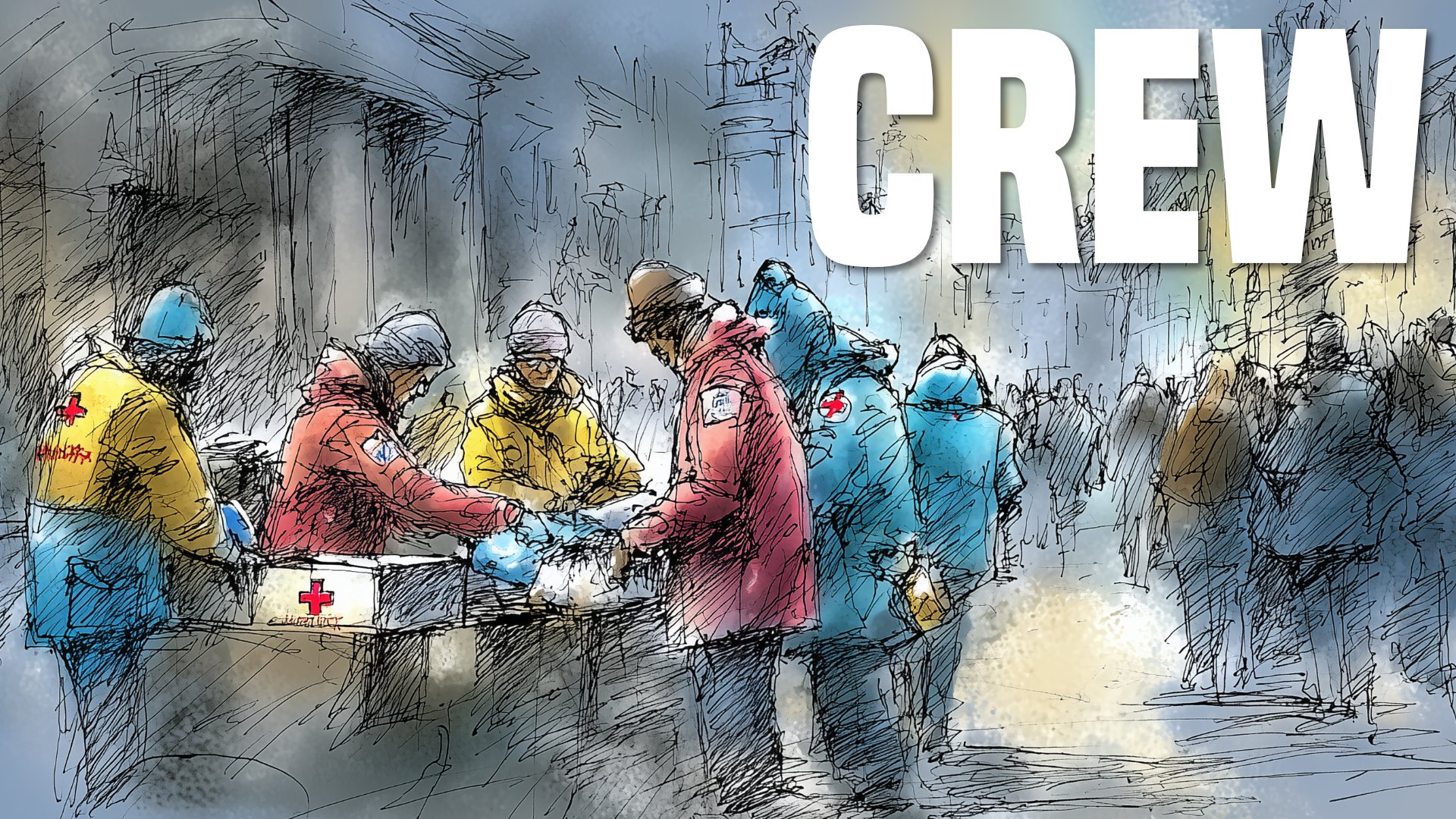
Season 3, Episode 7: Crew
And then in Season Three, the resurrected Jesus offers us the opportunity to help create this Big Story going forwards as part of the Crew. As we imagine ourselves watching this boxset, we are all part of the Cast, but God also invites us to part of the crew, to join him in his rescue mission of restoring and renewing this damaged world.
Just as Israel was called to be a people of God, each and everyone of us are called to be the people of God, who will “model” what it looks like to be in relationship with God, to love together, to give together and to serve together, so that others can do that too.
Not just as individuals but as communities.
People who don’t just want to be blessed, but who are blessed to be a blessing.
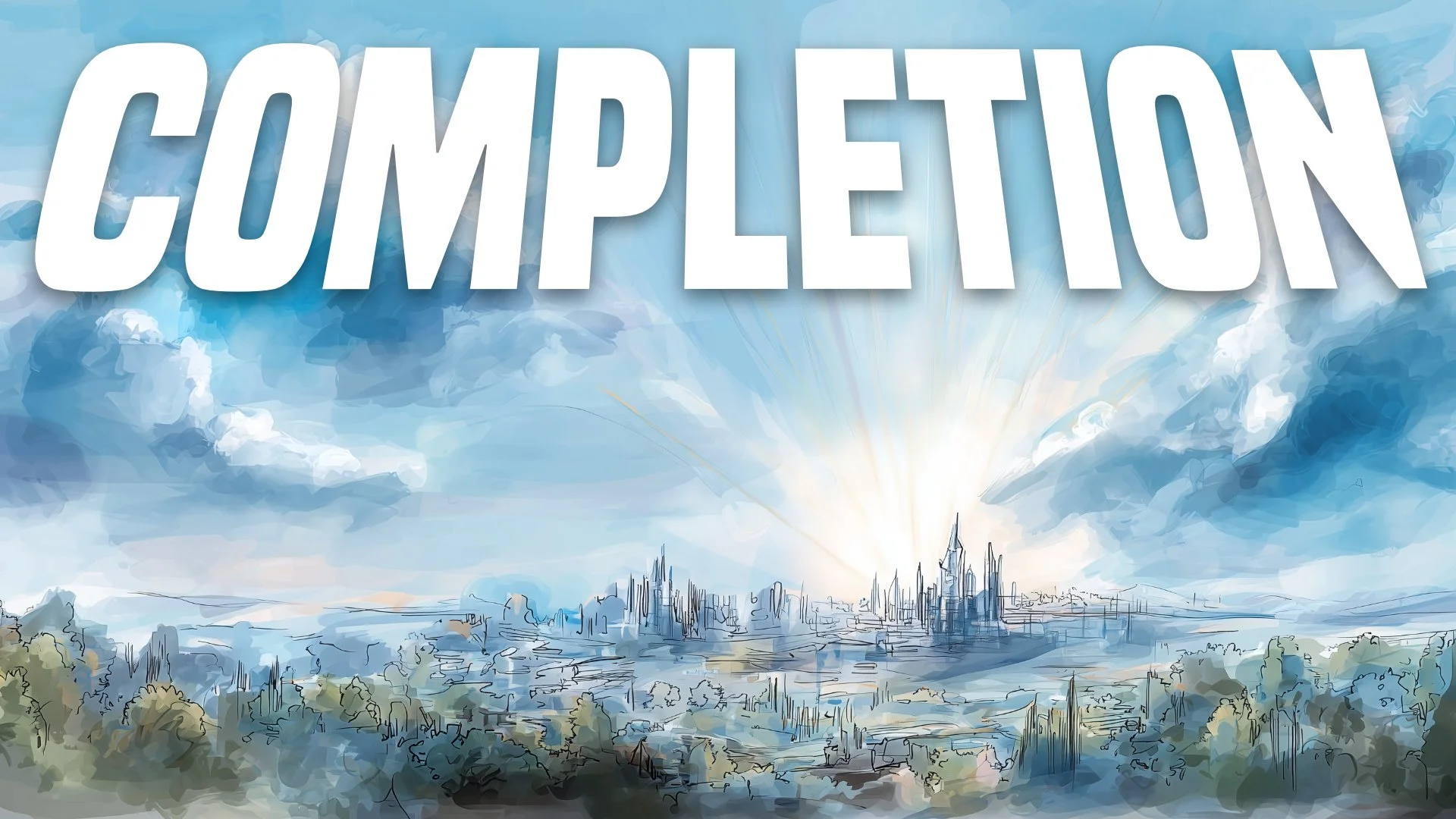
Season 3, Episode 8: Completion
And so this brings us onto the Season Three Finale
This is where we see how it’s all going to end, how the Story will come to its capital “C” “Completion.”
Or the technical word would be “Consummation.”
And just like there’s an original Creation at the beginning of the Bible, so too there’s a New Creation at the end of the bible, in the very last book, called Revelation. And again this is described in “picture language.”
In the book of Revelation, 21:1-5, it says,
Then I saw ‘a new heaven and a new earth,’ for the first heaven and the first earth had passed away … And I heard a loud voice from the throne saying, ‘Look! God’s dwelling-place is now among the people, and he will dwell with them. They will be his people, and God himself will be with them and be their God.
He will wipe every tear from their eyes. There will be no more death or mourning or crying or pain, for the old order of things has passed away.’
He who was seated on the throne said, ‘I am making everything new!’
Once again God speaks and a new Creation comes into being.
The reason there’s no more death or mourning or crying or pain, is because “the old order of things” is gone.
The good news is that because of Jesus THIS is not just a future reality when we will experience it in fulness, but it’s also something we can begin to experience breaking into our every day lives, even now.
Jesus says, “I am making all things new” - so when we see broken relationships repaired, communities restored, unjust situations put right, the vulnerable made safe, the hurting comforted, people made well - that’s all part of the end of this Big story to restore and renew all things.
And each of us can be part of this. Jesus said that all of the 613 Torah that the Israelites were first given, can be summed up in the two greatest commandments, to love God and to love other people. Every time we choose love over our own desires or needs, we are shaping the end of this big story.
Conclusion
Now this is one epic, exciting story, hope filled story, that involves each one of us.
And I’m just going to invite David to come and play for us as we take a moment to think about where we fit in this big story.
Where do you fit in this Big Story?
It may be that this is the first time you’ve even heard this in quite this way or maybe you’ve heard it a million times.
As you sit and reflect, what is God’s invitation to you?
Is God reaching out his hand to you, as a member of the cast of this big story - is God inviting you into a relationship with him? A relationship of knowing your are loved, you are safe, one where God wants to restore and renew you, for you to be free to be all that he made you to be. Is God reaching out his hand to you?
Is God reminding you of his incredible goodness, is he stirring you again for the things that stir him? Is he bringing to mind ideas of where you might be a part of the crew in this big story, restoring this damaged world. Maybe it’s a neighbour or work colleague that needs some support, maybe it’s volunteering with food bank or soup run, maybe its choosing to be a governor of your local school, whatever it might be, Is God stirring you, inviting you into something new?
More in this series